
October 10, 2026



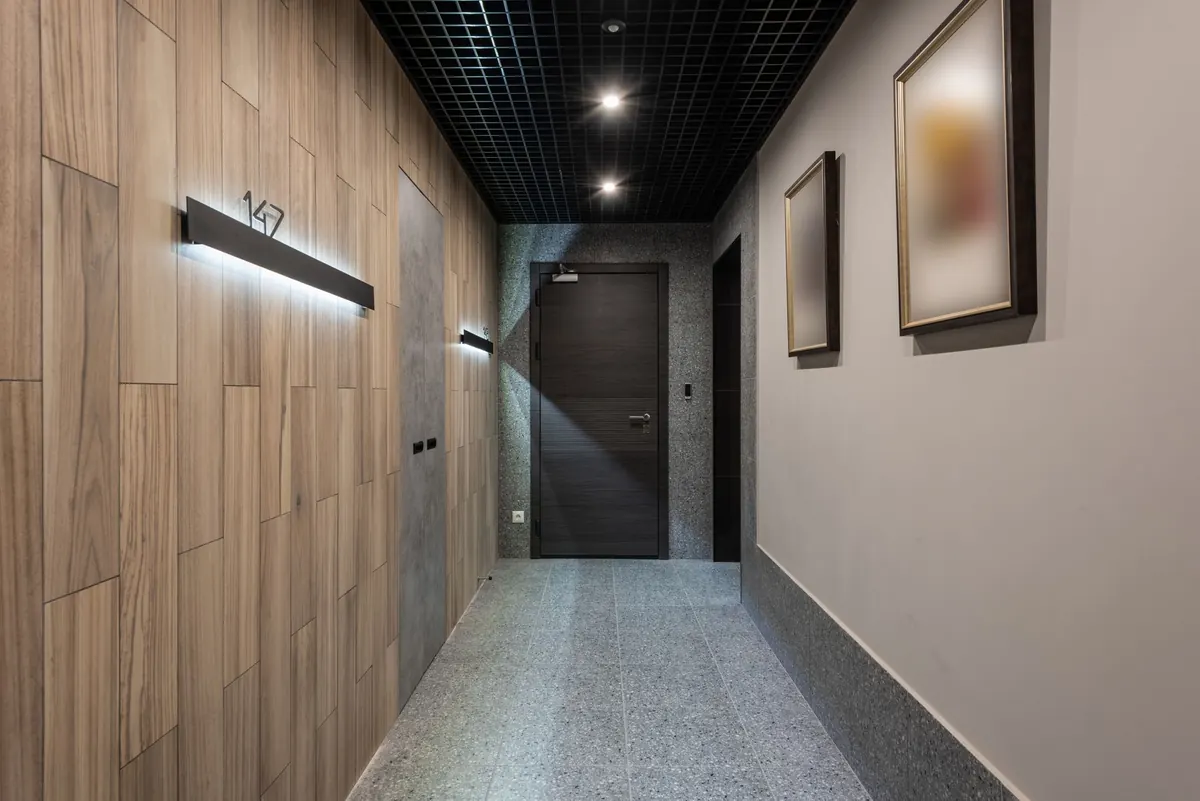
Most British hallways are leftovers. In a Victorian terrace, the hall is whatever space remained once the front room, the stairs and the back room had taken their share — often barely a metre wide, with no window and a ceiling that never quite justifies a pendant. Add four coats, a recycling bag and a pair of wellies, and it stops feeling like a room at all.
Happily, narrow hallways respond well to a few deliberate decisions. They will never feel generous, but they can feel calm, bright and easy to move through. Three things do most of the work: light, storage and colour. Treat them together and the results are far better than tackling them one at a time.
A single pendant in the middle of a narrow hall lights the middle of a narrow hall. The ends stay dim, the ceiling feels lower than it is, and anyone standing under it is lit unflatteringly from above.
Layered lighting solves most of that. Aim for three or four small sources, each doing a different job:
Choose warm white bulbs rather than cool white. Blue-ish light makes small, enclosed spaces feel clinical, which is the opposite of what a hallway needs.
Reflected light counts as much as emitted light. A mirror at the far end of the hall, or beside the front door, doubles whatever brightness you have and adds depth. Keep the ceiling pale. A row of downlights, by contrast, turns a narrow hall into a runway, so avoid them unless you need the output and can dim them.
If there is no wiring above the skirting, you are not stuck. Plug-in wall lights, rechargeable picture lights and a battery lamp on a shelf all give the same soft wash of light, and they can be moved about as the year turns — used constantly from October, barely at all in June. Put the door light on a timer or a sensor and the hall is lit before you reach the keyhole.
Dark hallways need warmth, not simply white. Brilliant white in a north-facing hall often reads grey by mid-afternoon; an off-white with a hint of yellow, pink or soft green holds up far better in low light.
The more effective trick is to give the eye as few stopping points as possible. Paint walls, ceiling, skirting, doors and any boxing in the same tone. When everything matches, the edges blur and the space reads as one continuous surface. Paint the ceiling white and the walls another colour and you have drawn a hard line across the top of the room, which drags the ceiling down.
In a narrow space, every contrast is a barrier. Every match is a metre gained.
A stronger colour works best at the end of the view. A deeper shade on the far wall, or on the inside of the front door, gives the eye somewhere to travel and makes the hall feel longer. Keep the long side walls lighter unless you actively want a snug, enclosed feel.
Finish matters too. Washable matt or eggshell on walls copes with shoulders and shopping bags, and eggshell on woodwork is far more forgiving than matt, which scuffs grey the first time a rucksack brushes past it. If you want to test a colour before committing, paint a large sheet of lining paper, tape it to the wall and leave it for a week; hallway light shifts more than almost any other room in the house.
Don't stop at the walls. Repeat the tone underfoot where you can. A pale runner that roughly matches the paint, or a floor painted one shade deeper, keeps the horizontal plane quiet so the eye reads one long volume rather than a box with a lid on it.
In a hallway, storage fails for one of two reasons: there isn't enough of it, or there is too much of it in the wrong place. The second is more common. A deep, generous cupboard that eats half the walkway is worse than three shallow ones that fit between the door frame and the stairs.
Everything should sit shallower than you expect. A 30cm-deep cabinet takes coats on slim hangers, a 20cm shelf takes hats, gloves and the post, and a row of hooks takes whatever is currently wet. Where the wall is genuinely deep — under the stairs, or in the return beside the front door — use full-depth joinery. Everywhere else, keep profiles slim so the walkway stays clear.
A bench with a lift-up lid is the best-value piece of hallway furniture there is: somewhere to sit and put shoes on, and somewhere to hide the shoes. Add a shallow drawer or a bowl on top for keys, and the flat surface stops becoming a dumping ground.
A hallway only stays tidy if each thing has an obvious place to land. That usually means:
Cull regularly, too. Hallways are where clutter accumulates quietly, and a coat you haven't worn in two years is costing you a square foot of the most valuable floor in the house.
Stand at your front door, look straight down the hall, and note what you see. That is the view you get every single day, and it matters more here than in a larger room. Keep the far end calm: nothing stacked against the end wall, nothing tall at the bend, no bulky furniture breaking the sightline. If the hall turns a corner, treat the corner as the destination and leave it empty.
Anything that draws the eye along the length rather than across the width helps. Floorboards running lengthwise, a runner, a strip of light, a repeated line of hooks — all pull the eye forward, and forward reads as further. A mirror at the end doubles the depth again. What you don't want is something that stops the eye halfway: a large dark picture on a side wall, a heavy radiator cover, a mountain of bags.
Mind the doorway itself, as well. A door that swings into the hall costs you a quarter of the floor space every time it opens; a sliding door, or one that swings outward, gives it straight back. If neither is possible, keep the swing arc completely empty — a hook above it rather than a console inside it.
None of this requires a builder or a large budget. Paint the ceiling the same colour as the walls, swap the pendant for a dimmer and two small wall lights, clear the floor except for one bench, and put a mirror where the sightline ends. That is a weekend's work, and it changes a hallway from a corridor you pass through into a room that holds you for a moment — which, in a house where space is short, is worth having.
Photo: Max Vakhtbovych / Pexels

Spruce up your home with wiring and renovation advice..
Copyright © 2026 Spruce Wire. All rights reserved. Spruce Wire.